Inclusive AI at Work: How UK Employers Can Protect Early-Career Opportunity While Redesigning Jobs
Artificial intelligence is changing the way work gets done. Tasks such as drafting, research, routine administration, basic analysis and customer correspondence can increasingly be automated or completed more quickly using AI tools. For employers, this creates opportunities to improve efficiency, free up employees’ time and rethink how work is organised.
But there is a question that deserves just as much attention as productivity: when AI takes over the tasks people traditionally learned from, how will the next generation of professionals gain the experience they need?
Early-career employees have never simply been there to complete routine work. Junior tasks provide opportunities to observe experienced colleagues, practise professional skills, understand organisational expectations and develop judgement through feedback. They help turn theoretical knowledge into practical capability.
When these tasks disappear, the learning opportunities attached to them can disappear too. Unless employers deliberately rethink how people learn on the job, they risk making it harder for people to get their foot in the door and build a career.
AI adoption is growing across UK businesses, with the proportion using the technology increasing from around 12% in late 2023 to around 35% by June 2026. However, adopting AI does not automatically mean that jobs will disappear. Some tasks may be automated while others change, and some organisations may slow recruitment or redesign entire roles.
The important distinction is between automating work and removing the opportunities through which people develop the skills to do it. For employers, understanding that difference is essential to planning a workforce that can adapt and grow.
Why this is an inclusion and culture issue
Access to work is not determined by recruitment decisions alone. It is also shaped by the experience employers expect candidates to have, the opportunities available to develop that experience and the support people receive once they join.
Consider what happens when an entry-level role changes. If an employer removes routine tasks but still expects candidates to demonstrate professional judgement, industry knowledge and AI proficiency from day one, the bar for getting that first opportunity may become harder to reach.
This creates particular challenges for people without established professional networks, those changing careers, people returning after a career break and candidates who have had fewer opportunities to gain relevant experience. Requiring previous AI experience can introduce another barrier if employers are not providing accessible training for people who have the potential to learn.
The people who already have access to professional networks, technology and development opportunities may be better placed to adapt. Those who rely on entry-level roles to gain their first meaningful experience could find themselves at a disadvantage. Without careful planning, AI-driven changes risk reinforcing inequalities that already exist in the workplace.
Recruitment technology presents another consideration. When AI is used to screen applications, assess candidates or support hiring decisions, employers need to understand how these systems work, where bias might arise and who could be unfairly excluded.
Inclusion also comes down to how people experience change at work. Employees need to feel comfortable asking questions, challenging AI-generated outputs and admitting when they do not understand a tool. If people fear being judged for uncertainty, they may hide mistakes rather than seek help.
AI can automate some tasks while supporting people to do others more effectively. Its impact depends partly on how organisations introduce the technology, redesign responsibilities and support employees through the transition.
That makes communication a central part of responsible AI adoption. Employees need to understand what is changing, why decisions are being made, which skills will matter, what training is available and how their performance will be assessed. They should also know which decisions remain their responsibility and when they are expected to challenge an AI-generated recommendation.
Introducing a new tool is one thing. Helping people understand what it means for their work, confidence and future opportunities is another. Both deserve attention.
Redesign early-career work, rather than erase it
The answer is not to preserve every routine task simply because it has always existed. It is to identify what people learn through those tasks and create new ways for them to develop the same capabilities.
For example, research tasks can become opportunities to check AI-generated information, verify sources and identify gaps. Communications work can involve reviewing AI drafts for accuracy, tone and accessibility. Data analysis can give junior employees the chance to validate findings, investigate unexpected results and explain what the numbers mean.
The focus shifts from completing a task to understanding it, questioning it and knowing what to do with the result.
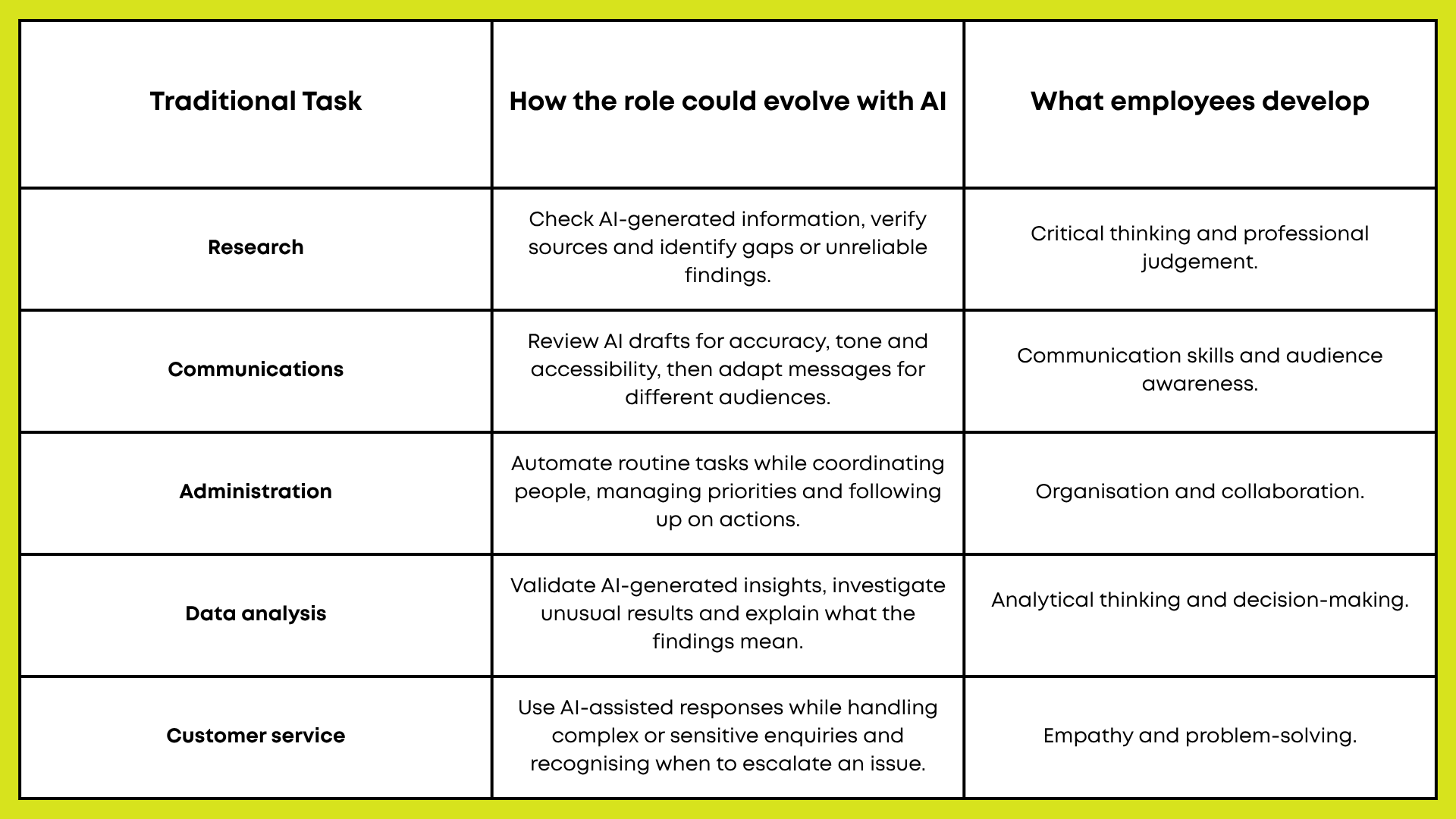
There is an important distinction here: asking someone to check AI's work is not automatically a development opportunity. If junior employees are simply expected to spot errors without the training, context or authority to understand them, the work may offer little meaningful learning.
A genuine human-in-the-loop role gives employees the knowledge and support to make informed decisions. They need to learn how to question outputs, recognise uncertainty, consider ethical implications, protect confidential information and identify when a decision needs to be escalated.
Employers must also be realistic about accountability. A junior employee cannot reasonably be expected to take responsibility for a consequential decision if they lack the expertise or authority to challenge the system supporting it.
The opportunity is to move away from repetitive execution towards supported judgement, with supervision, feedback and structured learning built into the role. That means treating job design as a development decision, not simply an efficiency exercise.
Build routes in, not just tools out
Redesigning roles is only part of the picture. Employers also need to consider how people will enter the organisation, gain experience and progress as the skills required for work change.
Apprenticeships offer one established route. They combine paid employment with structured learning, qualifications and workplace experience. England recorded 353,500 apprenticeship starts in the 2024/25 academic year, demonstrating the scale of this training pathway across different ages and career stages.
As work changes, apprenticeship programmes need to change with it. Apprentices should have opportunities to work on meaningful projects, learn from experienced colleagues and develop decision-making skills, rather than being limited to routine tasks that may soon be automated.
Rotations and internal mobility can help employees build experience across teams and develop skills they might otherwise gain only through informal networks. Clear application criteria, transparent selection and regular feedback make these opportunities easier to access fairly.
Returnships and re-entry programmes can help people rebuild confidence and update their skills after a career break. Time away from work should not automatically be treated as evidence of reduced capability. Refresher training, supported project work and opportunities to demonstrate current skills can help employers recognise what candidates bring, including transferable experience.
Mentoring and sponsorship also matter. Mentoring helps people learn, ask questions and navigate unfamiliar environments. Sponsorship can give them visibility and access to career-building assignments. Both are more equitable when opportunities are made available through transparent processes rather than depending entirely on who someone happens to know.
Paid internships and work experience can provide an important first step into an industry. These opportunities should be structured, paid where offered as employment or work experience, and transparently recruited. Unpaid placements and informal selection processes can favour people who can afford to work without income or already have access to professional networks.
These approaches should not sit separately from an organisation's AI strategy. They are part of ensuring that employers continue to develop the people they will need to use, evaluate and govern AI responsibly.
The question is not simply which skills an organisation needs today. It is how people will get the opportunity to develop the skills they will need tomorrow.
Move from credentials to capabilities
As roles change, employers also need to reconsider what makes someone qualified for an opportunity.
Skills-based hiring focuses on evidence of capability rather than relying too heavily on degrees, job titles or years of previous experience. Relevant capabilities may include curiosity, critical thinking, communication, collaboration, adaptability, ethical judgement, problem-solving and digital confidence.
This does not mean removing degree requirements indiscriminately. Some professions require specific qualifications, accreditation or regulated expertise. The aim is to distinguish what a role genuinely requires from recruitment conventions that may unnecessarily limit the pool of capable candidates.
Employers can start by reviewing job descriptions for unnecessary experience requirements, checking whether assessments reflect the work candidates will actually do and helping hiring managers recognise transferable skills.
Recruitment processes should also account for accessibility, disability-related adjustments, career breaks and the different ways candidates demonstrate their abilities.
AI-assisted recruitment needs the same level of scrutiny. Employers should understand the limitations of the tools they use, consider the risk of bias and ensure that human oversight is meaningful. Recruiters need to be able to question questionable recommendations rather than simply accepting a system's output.
Candidates should also have appropriate ways to raise concerns, while employers should monitor recruitment outcomes to identify whether particular groups are being disadvantaged.
Skills-based hiring is most effective when it connects directly to skills development. If organisations are willing to recruit people for their potential, they also need to invest in the training, support and feedback that allow that potential to grow.
Five questions for employers
As organisations redesign work around AI, leaders should ask themselves:
Which junior tasks are we automating, and what learning opportunities could disappear with them? Understand what employees currently gain from their work before deciding what to remove.
What skills and judgement should early-career employees develop? Define the capabilities that matter and create supervised opportunities to practise them.
Are our recruitment processes screening out capable people? Review experience requirements, assessments, accessibility and the use of AI in hiring.
Do our entry routes offer meaningful development and progression? Check whether apprenticeships, rotations, internships and return-to-work programmes provide skills, mentoring, visibility and access to future roles.
Have we communicated openly about how AI will affect work and career opportunities? Give employees clear information, opportunities to ask questions and ways to contribute to decisions about implementation.
These questions belong in workforce planning from the outset, rather than being considered once technology decisions have already been made.
Employers should also review what happens after implementation. Who is getting access to training? Who is being recruited into early-career roles? Who is progressing, and whose contributions are being recognised? Looking at these outcomes over time can help organisations understand whether their approach is creating opportunities or unintentionally narrowing them.
Make inclusion part of the future of work
AI does not make inclusive workplaces less important. It makes intentional job design, fair access to development and clear communication more important.
Employers can use AI to reduce repetitive work and give people more time for thoughtful, collaborative and human-centred contributions. But productivity gains will not automatically lead to fairer opportunities. That depends on the decisions organisations make about recruitment, training, accountability and progression.
The goal is not to preserve every entry-level task as it is. It is to preserve and improve the routes through which people gain experience, confidence, professional judgement and a sense of belonging.
That requires employers to look beyond what AI can do today and consider what their future workforce will need to learn, who will have access to those learning opportunities and how people will progress as roles evolve.
At Communicate Inclusively, we help organisations navigate change through inclusive communication, workplace culture and inclusion-focused support. If your organisation is introducing AI, redesigning roles or reviewing how change is communicated to employees, get in touch with Communicate Inclusively to discuss support tailored to your organisation's needs.
Inclusive AI begins with a simple principle: progress in technology should not come at the expense of progress in opportunity.